
Education to Career Pathways for Students with Average Marks | empower today | 2025
In today’s competitive world, there is a common misconception that only students with high grades can build successful careers. This belief often creates unnecessary pressure, especially for students who may not have scored top marks in school or college. The truth is, marks are not the only measure of intelligence or potential. Many successful entrepreneurs, leaders, and professionals were average students academically, but they excelled in other areas such as creativity, problem-solving, communication, or practical skills.
This article explores education-to-career pathways for students with average marks, proving that with the right strategy, skills, and mindset, you can still achieve career success.
Why Marks Are Not the Only Factor in Career Success
Good academic performance definitely helps, but it does not define your entire career journey. Employers today look for:
- Practical skills (technical or vocational)
- Soft skills (communication, teamwork, leadership)
- Adaptability (willingness to learn new technologies)
- Problem-solving ability
- Work ethic and discipline
A student with average marks can still outperform toppers if they invest in skill development and explore the right career pathway.
Step 1: Identify Strengths Beyond Academics
Before choosing a career, students should reflect on their strengths. Even if marks are average, you may have natural abilities such as:
- Creativity (design, writing, arts)
- Logical thinking (IT, finance, coding)
- Communication (sales, teaching, content creation)
- Hands-on skills (mechanical, electrical, construction, healthcare assistance)
Knowing your strengths will help you choose the right education-to-career pathway.
Step 2: Explore Alternative Education Options
If traditional degree-based education feels overwhelming, students with average marks can explore:
- Diploma Courses – Shorter, skill-focused programs in fields like IT, hospitality, design, or healthcare.
- Vocational Training – Hands-on skills such as welding, electrician training, plumbing, or automotive repair.
- Online Certifications – Platforms like Coursera, Udemy, and Google Career Certificates offer affordable courses in digital marketing, cloud computing, data analytics, and more.
- Community Colleges / Skill Development Programs – Especially useful in countries like India, the US, and Canada, where community-based education is affordable and practical.
Step 3: High-Demand Careers for Students with Average Marks
Here are some promising career paths that don’t strictly require top academic scores but value skills and performance:
1. Digital Marketing Specialist
Digital marketing has become a booming field. Companies hire marketers for SEO, social media, and paid advertising.
- No strict academic cut-off.
- Skills matter more than marks.
- High growth in freelancing and startups.
2. Graphic Designer / UI-UX Designer
Creativity often matters more than academic excellence. With software like Figma, Canva, and Photoshop, you can start designing for companies, websites, and mobile apps.
3. Cloud Computing and IT Support
Even with average marks, students can pursue certifications in AWS, Google Cloud, or Microsoft Azure. Entry-level roles like IT support, helpdesk engineer, or cloud technician are great starting points.
4. Sales and Business Development
If you have good communication and persuasion skills, sales roles in industries like FMCG, EdTech, or IT can pay extremely well. Many top sales professionals were not academic toppers.
5. Content Writing / Blogging / Freelancing
Writing skills, creativity, or even niche expertise (like cooking, gaming, or travel) can help build a career in content creation. With consistency, blogging and freelancing can even turn into full-time income.
6. Healthcare and Paramedical Careers
Courses like nursing, physiotherapy, lab technician, or emergency medical technician do not require top grades but provide stable and respected careers.
7. Skilled Trades
Electricians, plumbers, mechanics, and technicians are always in demand. These careers may not require high marks but require dedication and hands-on learning.
8. Hospitality and Tourism
Hotel management, event planning, and travel consultancy are great careers for those who enjoy interacting with people and managing services.
9. Cybersecurity Analyst (Entry-Level)
You don’t need to be a topper to enter cybersecurity. Starting as a SOC analyst or IT support security staff can lead to a rewarding career with certifications.
10. Entrepreneurship
Starting your own business — even a small one — doesn’t need high marks. What you need is vision, consistency, and the ability to learn from mistakes.
Step 4: Building Skills That Matter
Regardless of marks, certain skills are universally valuable:
- Communication – Employers value clear speakers and writers.
- Digital Literacy – Knowledge of MS Office, internet tools, and digital platforms.
- Problem Solving – Ability to handle challenges logically.
- Teamwork – Working well with others.
- Adaptability – Learning new technologies quickly.
These skills can be learned through practice, volunteering, internships, and online courses.
Step 5: Success Stories of Average Students
Many successful people were average students:
- Albert Einstein was considered a slow learner in school.
- Jack Ma, founder of Alibaba, failed multiple times in exams but became one of the richest entrepreneurs.
- Sachin Tendulkar, one of the greatest cricketers, wasn’t a top student academically but excelled in sports.
These stories prove that passion, consistency, and persistence matter more than marks.
FAQs on Career Paths for Students with Average Marks
Q1. Can I get a good job with low academic marks?
Yes. Many industries hire based on skills and performance rather than marks. Digital marketing, design, sales, and IT support are examples.
Q2. Is it possible to study abroad with average marks?
Yes. Many universities abroad accept students with average marks if they have good English proficiency (IELTS/TOEFL) or strong extracurricular achievements.
Q3. What is the best way to improve my career chances with average marks?
Focus on skill-building, internships, online certifications, networking, and consistent learning.
The Psychological Pressure of Marks on Students
One of the biggest challenges average students face is the societal pressure around marks. In many countries, especially in Asia, marks are often treated as the only benchmark of success. Students with low or average marks are sometimes labeled as “not smart enough” or “less capable.”
But the truth is, marks measure memory and exam performance, not intelligence. For example:
- A student who excels at mathematics may not do well in English exams, but that doesn’t make them less capable.
- A creative student may struggle with physics formulas, but could later become a successful designer, writer, or filmmaker.
- Many “average” students end up creating their own opportunities rather than following traditional career paths.
It is important to remind both students and parents that career success depends on consistent effort, learning attitude, and skill development — not just exam scores.
More Career Pathways for Average Students
In addition to the earlier list, here are more career options where marks are not the deciding factor:
11. Logistics and Supply Chain Management
This field is about ensuring smooth delivery of goods and services. With the growth of e-commerce and global trade, logistics managers are in demand.
- Required: Analytical thinking, organizational skills.
- Pathway: Diploma in supply chain management or MBA in logistics.
12. Film, Media, and Entertainment
Average marks don’t stop you from becoming a filmmaker, photographer, editor, or media professional. With YouTube, short films, and OTT platforms, opportunities are vast.
13. Sports and Fitness Careers
Many sportspeople were not academically strong but built careers as athletes, coaches, fitness trainers, or physiotherapists.
- Example: Virat Kohli was not a topper in academics but is one of the greatest cricketers in the world.
14. Aviation and Hospitality
Cabin crew, airport operations, hotel managers, and tourism consultants are respected and well-paying roles. Many of these careers prioritize personality, communication, and service skills over grades.
15. Vocational and Technical Jobs Abroad
Countries like Germany, Canada, and Australia value skilled technicians (electricians, welders, machine operators) much more than academic toppers. These roles are in shortage globally and can lead to permanent residency opportunities.
16. Data Entry, BPO, and Customer Support
While often seen as starting points, these jobs offer stability and allow students to build communication and problem-solving skills. Many professionals later move into management roles.
17. Creative Arts and Design
Fields like fashion design, interior design, animation, and game development are booming. Here, creativity and portfolio matter far more than grades.
18. Agriculture and Agri-Tech
With rising demand for food security and sustainable farming, careers in agriculture, agri-business, and organic farming are becoming popular. These are practical fields where passion matters more than marks.
The Role of Parents and Teachers
Parents and teachers often play a decisive role in shaping a student’s career. For average students, encouragement is critical. Instead of forcing them into highly competitive academic tracks, parents should:
- Identify the child’s natural talents – Some children are great at communication, others at building or creating.
- Support alternative careers – Not every child needs to be an engineer, doctor, or topper.
- Reduce comparison – Comparing with toppers can lower confidence.
- Celebrate small wins – Internships, skill certificates, or project achievements should be valued.
A supportive environment boosts self-esteem and encourages students to try new things without fear of failure.
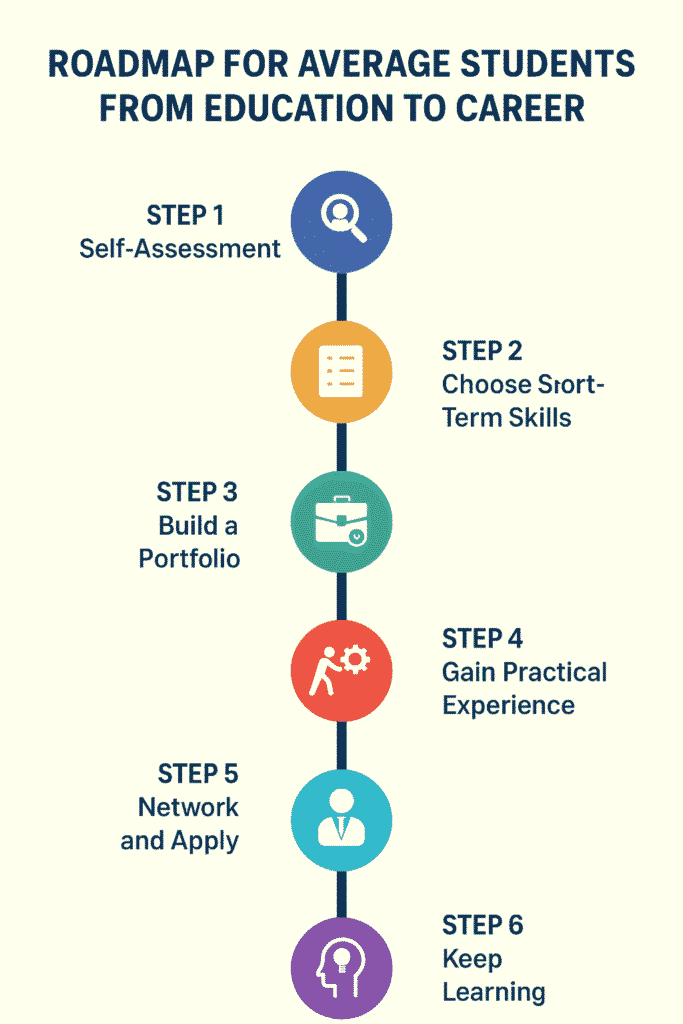
Roadmap: Education to Career for Average Students
Here’s a step-by-step roadmap to help average students move from education to a career:
Step 1: Self-Assessment
- List out your interests and strengths.
- Use career assessment tests to explore fields.
Step 2: Choose Short-Term Skills
- Pick one or two skills (e.g., digital marketing + graphic design).
- Take online certifications to build credibility.
Step 3: Build a Portfolio
- Create small projects or internships.
- Show real work instead of just certificates.
Step 4: Gain Practical Experience
- Volunteer, freelance, or take part-time jobs.
- Real-world exposure matters more than marks.
Step 5: Network and Apply
- Use LinkedIn, job boards, and communities to connect.
- Showcase skills and portfolio in resumes.
Step 6: Keep Learning
- Upskill every year.
- Move from beginner to intermediate to advanced roles.
This step-by-step journey ensures that even with average marks, students can systematically build a career.
Why Employers Don’t Just Look at Marks
In the modern job market, many recruiters admit that marks are just one factor. They also check:
- Practical skills – Can you solve real problems?
- Communication ability – Can you work in teams?
- Adaptability – Are you willing to learn new technologies?
- Attitude – Do you show persistence and responsibility?
This is why many students with average marks still get good jobs, promotions, and even leadership roles.
Final Thoughts
Being an average student does not mean you are destined for an average career. Marks are just one part of your profile. With the right combination of skills, certifications, internships, and career strategies, you can build a successful future in fields like digital marketing, cloud computing, design, healthcare, sales, or even entrepreneurship.
The education-to-career pathway for students with average marks is filled with opportunities, flexibility, and growth potential. While academic toppers may have an advantage in traditional career tracks like medicine or engineering, average students can shine in creative, technical, vocational, and entrepreneurial fields.
If you are a student with average marks, do not lose hope. Focus on what you enjoy, invest in building practical skills, and take one step at a time. Your marks may be average, but your career potential can be extraordinary.
Remember: Employers don’t just hire toppers, they hire problem solvers. If you are willing to learn, adapt, and work hard, you can transform your career — no matter what marks you scored in school or college.
Table of Contents
follow for more updates