
Future Careers in Space Tech Beyond Astronauts | empower Now | 2025
When most people think of Future space exploration, the first image that often comes to mind is that of an astronaut floating weightlessly in space. While astronauts are the most visible figures in space missions, they represent just a small fraction of the vast and rapidly expanding space technology industry.
The future of space is no longer limited to government agencies like NASA or ISRO. Today, private companies like SpaceX, Blue Origin, and Rocket Lab are leading groundbreaking innovations. This shift has created a massive demand for skilled professionals in a variety of roles — many of which have nothing to do with strapping into a rocket and traveling to space.
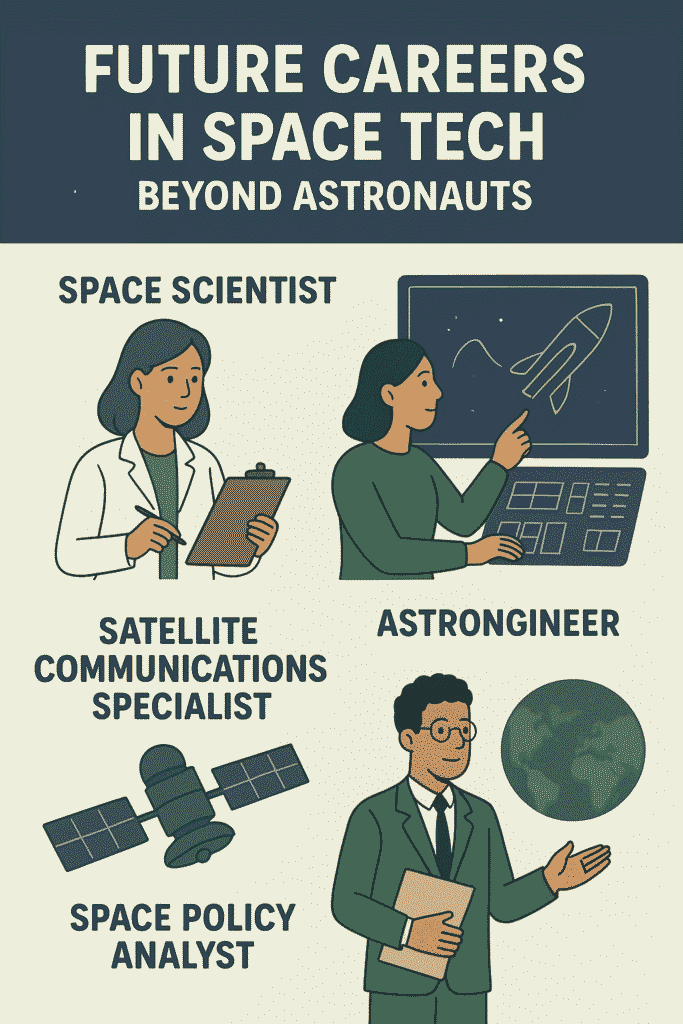
For students, graduates, and professionals, this means there are countless career opportunities in space tech beyond becoming an astronaut. These careers are diverse, ranging from engineering and research to business, data analysis, law, and even marketing.
In this article, we’ll explore emerging roles in the space industry, the skills required, future trends, and how you can position yourself to thrive in one of the most exciting industries of the 21st century.
The Expanding Space Industry
The global space industry has been growing at an unprecedented rate. According to reports, the global space economy was valued at over $550 billion in 2023 and is expected to surpass $1 trillion by 2030. This growth is driven by:
- The rise of private space companies competing to develop cost-effective launch systems.
- Innovations in satellite technology for communication, weather forecasting, and navigation.
- Government initiatives to encourage space research and development.
- Increasing demand for space tourism and commercial space travel.
- Applications of space technology in industries such as agriculture, defense, and disaster management.
This rapid expansion has opened the door for a wide range of non-astronaut roles that are essential to the functioning of this ecosystem.
Key Space Tech Careers Beyond Astronauts
Here are some of the most promising and in-demand careers in the space sector that go beyond the traditional astronaut role:
1. Aerospace Engineers
Aerospace engineers are the backbone of the space industry. They design and develop spacecraft, satellites, rockets, and propulsion systems. These engineers focus on making vehicles safer, lighter, and more efficient while ensuring they can withstand the extreme conditions of space.
Skills Required:
- Strong knowledge of physics and mathematics.
- Proficiency in CAD software and simulation tools.
- Understanding of aerodynamics, propulsion, and thermodynamics.
- Problem-solving and critical thinking abilities.
Career Opportunities:
You can work with organizations like NASA, ISRO, SpaceX, or companies involved in aircraft and spacecraft manufacturing.
2. Satellite Communications Specialists
Satellites play a vital role in everything from global communication to weather forecasting and GPS navigation. Satellite communication specialists design, manage, and maintain these systems, ensuring reliable data transmission between Earth and orbiting satellites.
Why It’s Important:
As more industries depend on satellite data, the demand for skilled professionals in this area will continue to rise.
Key Skills:
- Knowledge of networking and telecommunications.
- Experience with satellite hardware and software systems.
- Understanding of radio frequency (RF) engineering.
3. Astrobiologists
Astrobiology is the study of life beyond Earth. Astrobiologists explore whether other planets or moons have conditions that could support life. They also study the origins of life and how organisms adapt to extreme environments, both in space and on Earth.
Fields of Study:
- Microbiology
- Geology
- Chemistry
- Planetary science
Career Scope:
Work in research institutions, space agencies, and universities, contributing to missions that explore planets like Mars or icy moons like Europa.
4. Space Lawyers
With space tourism, asteroid mining, and satellite deployment becoming common, there’s a growing need for space law professionals. Space lawyers handle legal aspects such as international treaties, intellectual property rights, liability issues, and commercial agreements for space missions.
Key Responsibilities:
- Drafting contracts for space companies.
- Ensuring compliance with global space treaties like the Outer Space Treaty.
- Handling disputes related to satellite collisions or space debris.
Skills Required:
- Law degree with specialization in space or international law.
- Strong negotiation and analytical skills.
5. Space Data Analysts
Satellites and telescopes generate massive amounts of data every day. Space data analysts process and interpret this data to support applications like climate change tracking, defense, urban planning, and disaster management.
Key Skills:
- Data science and machine learning.
- Programming skills in Python, R, or similar languages.
- Knowledge of remote sensing and GIS (Geographic Information Systems).
Career Scope:
Work with government agencies, environmental organizations, or private companies using satellite data for commercial purposes.
6. Robotics Engineers for Space
Robotics plays a crucial role in space exploration, especially for missions where sending humans is too risky or expensive. Robotics engineers design and develop robotic arms, rovers, and autonomous systems for planetary exploration.
Examples:
- Mars rovers like Perseverance and Curiosity.
- Robotic arms used in space stations for repairs and maintenance.
Skills Needed:
- Mechanical and electrical engineering.
- Knowledge of artificial intelligence and automation.
- Proficiency in robotics programming languages.
7. Planetary Geologists
Planetary geologists study the surfaces, compositions, and histories of planets, moons, and asteroids. Their research helps determine which celestial bodies might support future human settlements or hold valuable resources.
Applications:
- Supporting mining missions on asteroids or the Moon.
- Identifying landing sites for spacecraft.
- Studying planetary evolution for scientific insights.
8. Space Medicine Specialists
Space travel poses unique health challenges like muscle atrophy, radiation exposure, and psychological stress. Space medicine specialists work to ensure the physical and mental well-being of astronauts and space tourists.
Career Paths:
- Medical researchers focused on space health.
- Flight surgeons working directly with astronauts.
- Developing new treatments for space-related health issues.
9. Space Tourism and Hospitality Managers
With companies like SpaceX and Blue Origin working on commercial space travel, there is a need for professionals to manage space tourism operations. These roles include hospitality management, spaceflight customer service, and experience design for tourists.
Future Opportunities:
Imagine luxury hotels orbiting Earth or adventure trips to the Moon — this sector could become a multi-billion-dollar industry by 2040.
10. Space Policy Analysts
Governments and organizations need experts to develop policies that ensure space remains safe, sustainable, and conflict-free. Space policy analysts evaluate international relations, defense strategies, and ethical concerns related to space exploration.
Skills Required:
- Political science and policy analysis.
- Understanding of space treaties and international relations.
- Strong research and communication skills.
How to Prepare for a Career in Space Tech
Pursuing a career in space technology requires careful planning and skill-building. Here are steps you can take to prepare:
1. Choose the Right Education Path
Select a degree that aligns with your career interests:
- Engineering for technical roles like spacecraft design or robotics.
- Physics or astronomy for research-oriented careers.
- Computer science for data analysis or AI-based roles.
- Law for space legal careers.
- Environmental science for sustainability and planetary exploration.
2. Gain Relevant Skills
Beyond formal education, develop additional skills:
- Programming (Python, MATLAB, C++).
- Data analysis and machine learning.
- Communication and teamwork.
- Critical thinking and problem-solving.
3. Engage in Internships and Research
Internships with organizations like ISRO, NASA, or private space startups can give you hands-on experience and networking opportunities.
Participate in research projects or competitions like NASA’s Space Apps Challenge to build your portfolio.
4. Stay Updated on Space Trends
The space industry evolves rapidly. Stay informed by following space news, attending webinars, and reading journals about advancements in space tech, robotics, and satellite systems.
5. Network with Professionals
Join space-related organizations and forums to connect with industry experts. Networking can open doors to job opportunities and mentorship.
Future Trends Shaping Space Careers
The next decade will bring transformative changes to the space industry. Some emerging trends include:
- Space Mining: Extracting resources like water and rare metals from asteroids.
- Space Habitats: Building sustainable settlements on the Moon and Mars.
- Artificial Intelligence: Automating spacecraft navigation and mission planning.
- Reusable Rockets: Lowering the cost of space travel through innovations in rocket technology.
- Commercial Space Stations: Private companies developing orbiting stations for tourism and research.
These trends will create entirely new roles and demand professionals with diverse skill sets.
Why Space Tech is a Great Career Choice
- High Demand for Talent: The rapid expansion of the space industry ensures job stability and growth opportunities.
- Innovation and Creativity: Space tech encourages problem-solving and groundbreaking innovations.
- Global Collaboration: Work with experts and organizations worldwide.
- Societal Impact: Contributions to space technology can improve life on Earth, from weather forecasting to disaster management.
- Exciting and Rewarding: Few industries offer the same level of excitement and the chance to work on historic missions.
Conclusion
While becoming an astronaut remains a dream for many, the future of space exploration relies on countless professionals working behind the scenes. From engineers and data scientists to space lawyers and tourism managers, there is a career path for almost every interest and skill set.
By gaining the right education, building relevant skills, and staying informed about industry trends, you can position yourself for a successful career in this rapidly growing field. Space is no longer the final frontier — it’s the next big opportunity for ambitious students and professionals worldwide.
The sky is no longer the limit — it’s just the beginning.
Table of Contents
follow us on whats app channel