
Neurodiverse-Friendly Careers (for Students with ADHD, Dyslexia, Autism) | Empower Today |2025
The world is slowly starting to recognize that neurodiversity is not a limitation but a strength. For years, individuals with conditions like ADHD, dyslexia, and autism were often misunderstood and overlooked in education and the workplace. Today, however, attitudes are shifting, and organizations are realizing the unique value that neurodiverse individuals bring to the table.
Neurodiverse students are creative thinkers, problem solvers, and innovators. They often excel in areas where others struggle, thanks to their distinctive ways of processing information and approaching challenges. But to thrive, they need careers that embrace their differences and allow them to shine without forcing them into a one-size-fits-all mold.
In this article, we will explore what neurodiversity really means, the strengths of individuals with ADHD, dyslexia, and autism, and career paths that align with their skills and interests. We will also discuss how to prepare for these careers and create a fulfilling future built on confidence and purpose.
Understanding Neurodiversity
Neurodiversity is a concept that views neurological differences as natural variations of the human brain rather than deficits. Just as biodiversity strengthens ecosystems, neurodiversity enriches human societies.
The term covers a range of conditions, including:
- ADHD (Attention Deficit Hyperactivity Disorder): Characterized by high energy, creativity, and a strong ability to think outside the box, but often with challenges in focus and time management.
- Dyslexia: A learning difference that affects reading and writing but is often linked to exceptional problem-solving and big-picture thinking.
- Autism Spectrum Disorder (ASD): A condition where individuals may have unique communication styles and strong attention to detail, along with intense focus on specific interests.
Recognizing and embracing these differences is essential for both education and employment. With the right support, neurodiverse individuals can thrive in careers that leverage their strengths.
The Strengths of Neurodiverse Students
Every neurodiverse condition comes with its own set of natural abilities. Understanding these strengths can help students choose careers where they will excel.
ADHD Strengths
Students with ADHD are often energetic, spontaneous, and highly creative. They tend to thrive in fast-paced environments where no two days are the same. Many are natural problem-solvers and innovators, making them well-suited to roles that require brainstorming, experimentation, and quick thinking.
Common strengths include:
- High levels of energy and enthusiasm.
- Ability to hyperfocus on tasks they are passionate about.
- Out-of-the-box creativity and innovative thinking.
- Strong adaptability in dynamic environments.
Dyslexia Strengths
Contrary to the misconception that dyslexia is solely a reading issue, individuals with dyslexia are often exceptional visual thinkers and strategists. They tend to see the bigger picture and make connections that others might miss.
Key strengths include:
- Exceptional problem-solving and critical thinking skills.
- Strong visual-spatial abilities, which are crucial in design and engineering fields.
- Creativity in art, storytelling, and innovation.
- Ability to simplify complex ideas and communicate them visually.
Autism Strengths
Autistic individuals often have extraordinary attention to detail, persistence, and deep expertise in subjects they are passionate about. They thrive in structured environments where precision and focus are valued.
Core strengths include:
- Ability to concentrate deeply on specialized tasks.
- High levels of accuracy and reliability.
- Logical, structured thinking and pattern recognition.
- Exceptional memory for facts and processes.
Choosing the Right Career Path
The key to success for neurodiverse students lies in finding careers that celebrate their unique abilities rather than trying to “fix” what makes them different. Here are some ideal career options for each group, along with why they are a good fit.
Careers for Students with ADHD
Students with ADHD tend to thrive in roles that are fast-paced, dynamic, and hands-on. They do best in environments where creativity and energy are assets rather than distractions.
Recommended career paths:
- Entrepreneurship: Running their own business allows for flexibility, independence, and the ability to follow their passions.
- Creative industries: Roles in advertising, content creation, design, and filmmaking encourage free-flowing ideas.
- Healthcare professions: Emergency medicine, nursing, or physiotherapy suit their high energy and problem-solving skills.
- Sales and marketing: These fields reward enthusiasm, quick thinking, and strong interpersonal skills.
- Event planning or hospitality: Dynamic environments that require multitasking and adaptability.
Careers for Students with Dyslexia
Dyslexic individuals excel in areas where visual thinking, strategy, and innovation are required. They often thrive in roles that allow them to express ideas beyond written text.
Promising career options:
- Architecture and interior design: Visual-spatial strengths are highly valuable here.
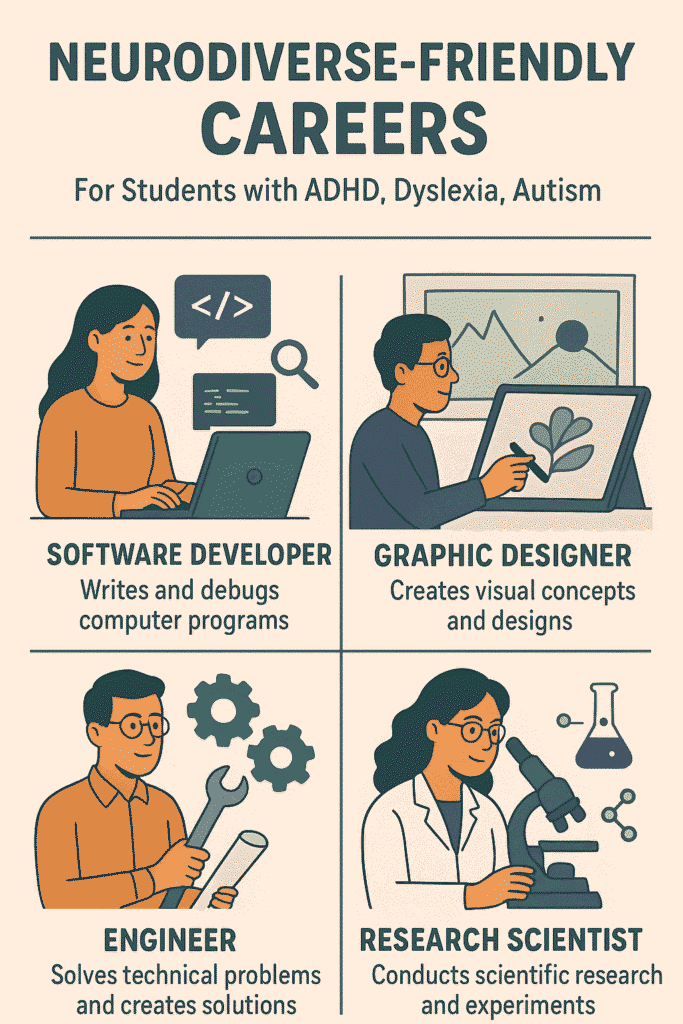
- Engineering and product design: Innovative problem-solving makes them ideal for these roles.
- Animation and graphic design: Careers where visual storytelling takes center stage.
- Entrepreneurship: Many dyslexic individuals have a natural ability to identify opportunities and lead teams.
- Technology development: Especially roles focused on big-picture planning and creative solutions.
Careers for Students with Autism
Students on the autism spectrum tend to do best in careers where structure, focus, and deep expertise are rewarded. Roles that require precision and detail-oriented work are particularly well-suited.
Top career paths:
- Software development and programming: Logical thinking and pattern recognition make autistic individuals natural coders.
- Data analysis: Their attention to detail helps identify trends and errors others might miss.
- Accounting or financial analysis: Structured tasks and clear processes fit well with their strengths.
- Scientific research: Many autistic individuals thrive in research environments where they can focus deeply.
- Engineering and quality control: Roles that require exactness and systematic problem-solving.
How to Prepare for a Neurodiverse-Friendly Career
Finding the right career path is just the first step. To truly succeed, neurodiverse students should focus on preparation, skill-building, and self-advocacy.
1. Identify Your Strengths and Interests
Begin by reflecting on what you enjoy and what comes naturally to you. This will help you choose a career path that feels fulfilling rather than overwhelming.
- Are you energized by creativity and brainstorming?
- Do you prefer structured, repetitive tasks with clear expectations?
- Are you most productive when working independently or as part of a team?
Answering these questions can guide your choices.
2. Seek Tailored Education and Training
Traditional learning environments can be challenging for neurodiverse students. Look for programs that offer:
- Flexible teaching methods, such as visual learning tools or project-based learning.
- One-on-one mentoring or tutoring.
- Accommodations like extended time on tests or alternative assignment formats.
Online courses can also be a great option, allowing students to learn at their own pace.
3. Develop Soft Skills
While technical skills are important, soft skills like communication, teamwork, and problem-solving are equally crucial.
Neurodiverse students can work on:
- Practicing active listening and clear communication.
- Learning conflict resolution and emotional regulation.
- Building confidence through public speaking or group projects.
4. Gain Real-World Experience
Internships, part-time jobs, and volunteer opportunities are invaluable for building confidence and understanding workplace dynamics.
Even short-term experiences can:
- Help students identify preferred work environments.
- Build a portfolio of skills and accomplishments.
- Offer networking opportunities for future employment.
5. Leverage Support Networks
Many universities, colleges, and workplaces now have support systems for neurodiverse individuals.
These include:
- Career counseling tailored to neurodiverse students.
- Employee resource groups in companies.
- Advocacy organizations that provide mentorship and resources.
Employers That Embrace Neurodiversity
Today, many forward-thinking companies are actively recruiting neurodiverse talent. Some well-known examples include:
- Microsoft: Their Autism Hiring Program focuses on finding tech talent with unique problem-solving skills.
- SAP: Their Autism at Work initiative provides structured support for autistic employees.
- EY (Ernst & Young): Known for recruiting individuals with dyslexia for their exceptional analytical abilities.
- Google and IBM: Both have diversity programs aimed at supporting neurodiverse hires.
These companies understand that neurodiverse employees bring perspectives and talents that can lead to groundbreaking innovations.
Overcoming Challenges in the Workplace
While progress has been made, neurodiverse individuals may still face barriers such as misunderstanding, stigma, or lack of accommodations. Here are strategies to overcome these challenges:
- Self-advocate: Clearly communicate your needs and preferences to employers or educators.
- Use assistive technology: Tools like text-to-speech software or scheduling apps can reduce daily stressors.
- Educate others: Raising awareness about neurodiversity can foster a more inclusive environment.
- Find mentors: A supportive mentor can provide guidance, encouragement, and career advice.
Why Neurodiverse Careers Benefit Everyone
Embracing neurodiversity is not just good for individuals — it’s beneficial for society and businesses as a whole.
Neurodiverse teams:
- Drive innovation through diverse perspectives.
- Improve problem-solving by combining different thinking styles.
- Enhance productivity with employees who excel in specialized areas.
- Create more inclusive workplaces, fostering loyalty and collaboration.
Companies that actively recruit and support neurodiverse individuals often report higher employee satisfaction and stronger business outcomes.
Final Thoughts
Neurodiversity is a gift. The unique perspectives and talents of students with ADHD, dyslexia, and autism are essential for building a more innovative and inclusive world.
Finding a career that aligns with your strengths can lead to a fulfilling, successful future — one where you are celebrated for who you are, not judged for what you are not.
For neurodiverse students, the journey may come with challenges, but it also brings incredible opportunities. By embracing your abilities, seeking the right support, and choosing a path that fits your natural talents, you can create a career that not only sustains you but also makes a difference in the world.
The future of work is diverse — and there’s a place for everyone in it.
Table of Contents
Follow us on whatsapp channel