
Emerging Careers in Virtual Reality (VR) & Augmented Reality (AR) for Education | Empower 2025
Education has always evolved alongside technological advancements. From chalkboards to smartboards and now to immersive learning experiences, the way we teach and learn is constantly changing. Today, two groundbreaking technologies — Virtual Reality (VR) and Augmented Reality (AR) — are reshaping the future of education in ways we never imagined.
These innovations are not just improving learning methods; they are creating new career paths for students and professionals who want to work at the intersection of technology, creativity, and education.
In this article, we will explore how VR and AR are transforming education, the exciting career opportunities they bring, and how you can prepare yourself for this rapidly growing industry.
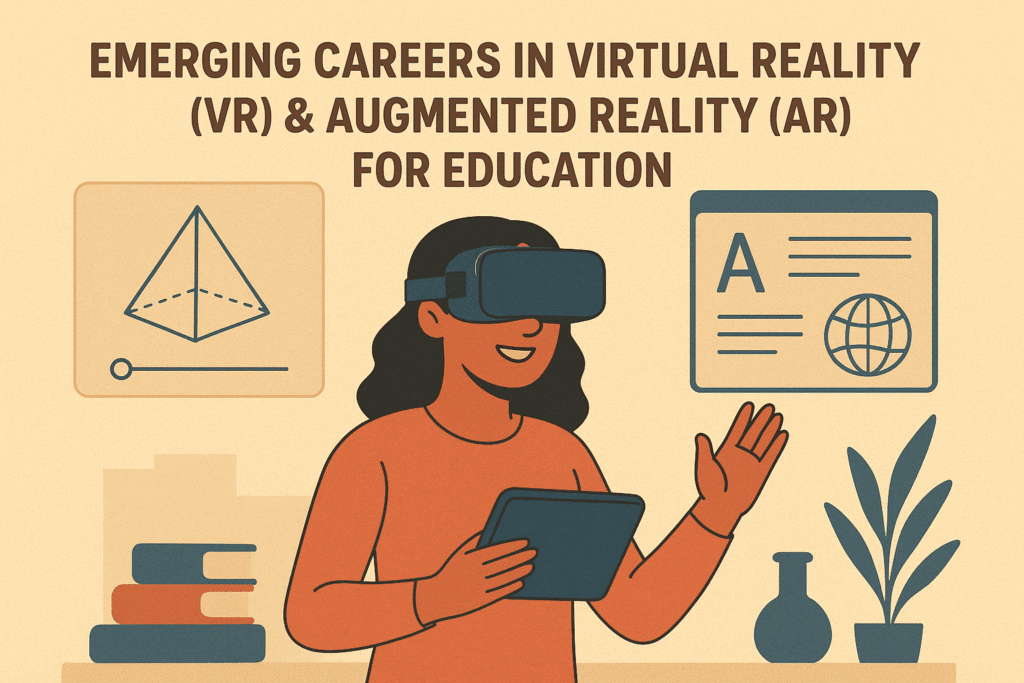
Understanding VR and AR in Education
Before we dive into career opportunities, let’s first understand what these technologies are and how they are applied in the education sector.
- Virtual Reality (VR) creates a fully immersive digital environment. Students wear VR headsets and are transported into a simulated world where they can interact with objects and scenarios as if they were real.
Example: A student studying biology can virtually walk through the human circulatory system and see how blood flows through veins and arteries. - Augmented Reality (AR) overlays digital information on top of the real world, enhancing what students see through devices like smartphones, tablets, or AR glasses.
Example: AR apps can bring textbook images to life, allowing students to see a 3D model of the solar system floating right on their desks.
Both technologies are revolutionizing education by making learning interactive, engaging, and hands-on. This opens the door to a wide range of career opportunities for those passionate about technology and education.
The Rise of Immersive Learning
Traditional education methods often rely on textbooks, lectures, and rote memorization. While effective in some cases, they can lack engagement and fail to address different learning styles.
VR and AR are changing this by introducing immersive learning experiences. Here’s why immersive learning is gaining momentum:
- Higher Engagement: Students are more likely to stay focused when they are actively involved in a virtual or augmented environment.
- Better Retention: Studies show that people remember concepts more effectively when they experience them rather than just read about them.
- Safe Practice Environments: Complex or risky activities, like medical surgeries or chemical experiments, can be simulated without danger.
- Global Accessibility: Students in remote areas can access the same high-quality resources as those in well-funded urban schools.
This surge in immersive learning has fueled demand for skilled professionals who can design, develop, and manage VR and AR education tools.
Why VR and AR Careers Are the Future of Education
The global VR and AR market in education is growing at an unprecedented rate. According to industry reports:
- The AR and VR education market is expected to exceed $30 billion by 2030.
- Demand for AR and VR specialists is projected to grow by over 35% annually.
As more schools, universities, and corporate training programs adopt these technologies, the need for talented professionals will only increase.
This growth represents a golden opportunity for students and job seekers who want to build careers in an emerging, future-ready field.
Key Career Paths in VR and AR for Education
Here are some of the most promising careers in VR and AR focused on the education sector:
1. VR/AR Instructional Designer
Instructional designers create immersive learning content tailored to educational needs.
- They design lesson plans that leverage VR and AR to explain complex concepts.
- Skills needed include educational psychology, curriculum development, and technical knowledge of VR/AR platforms.
Example: Designing a VR simulation that helps engineering students understand structural mechanics by building virtual bridges.
2. VR/AR Content Developer
Content developers create the actual digital assets and experiences used in VR and AR applications.
- This role involves 3D modeling, animation, and interactive storytelling.
- Popular tools include Unity, Unreal Engine, and Blender.
Example: Creating realistic 3D models of planets for an AR astronomy app used in schools.
3. Educational Technology Specialist
These professionals help schools and institutions implement VR and AR solutions effectively.
- They act as a bridge between tech developers and educators.
- Skills required include project management, training, and understanding of classroom dynamics.
Example: Training teachers to use VR headsets and AR applications during science lessons.
4. VR/AR Software Developer
Software developers write the code that powers VR and AR educational apps.
- Strong programming skills in languages like C#, Python, or JavaScript are essential.
- This role is perfect for those passionate about problem-solving and innovation.
Example: Building a VR app that lets history students experience ancient civilizations firsthand.
5. Immersive Experience Researcher
Research is crucial for understanding how VR and AR impact learning outcomes.
- These professionals conduct studies, analyze data, and develop best practices.
- Often work in collaboration with universities or research institutes.
Example: Measuring how VR-based anatomy lessons improve medical students’ understanding compared to traditional textbooks.
6. AR/VR Hardware Specialist
As demand grows, there’s also a need for specialists in hardware development and maintenance.
- This includes designing headsets, sensors, and haptic devices.
- Opportunities exist in both product development and technical support.
Example: Working for a company that develops affordable VR headsets for schools in rural areas.
7. Corporate Training Specialist
Beyond traditional education, VR and AR are revolutionizing corporate training.
- Corporations need experts to design immersive training modules for employees.
- This is especially valuable in industries like healthcare, aviation, and manufacturing.
Example: Creating a VR training program for factory workers to practice safety protocols.
Skills Required for a Career in VR and AR Education
To succeed in this field, you need a mix of technical expertise and soft skills. Here’s what to focus on:
- Technical Skills:
- Proficiency in VR/AR development platforms (Unity, Unreal Engine).
- Knowledge of 3D modeling and animation.
- Coding languages like C#, Python, or JavaScript.
- Familiarity with ARKit, ARCore, and WebXR.
- Creative Skills:
- Storytelling to make lessons engaging.
- Visual design and user experience (UX) principles.
- Problem-solving and innovative thinking.
- Soft Skills:
- Communication to collaborate with educators and tech teams.
- Project management to handle complex deployments.
- Adaptability to stay current with evolving technologies.
By developing these skills, you’ll be ready to thrive in this fast-growing industry.
How Students Can Prepare for VR/AR Careers
If you’re a student interested in this exciting field, here’s how to get started:
- Enroll in Online Courses:
Platforms like Coursera, Udemy, and edX offer beginner-friendly VR/AR development courses. - Build a Portfolio:
Create small projects, like AR apps or VR experiences, to showcase your skills to potential employers. - Participate in Hackathons:
These events provide real-world problem-solving experience and networking opportunities. - Internships and Apprenticeships:
Seek internships with companies developing VR and AR tools for education. - Join Communities:
Engage with online forums, LinkedIn groups, and local meetups focused on immersive technology.
Real-World Applications of VR and AR in Education
The potential applications of VR and AR in education are vast. Here are some inspiring examples:
- Medical Training: VR simulations allow medical students to practice surgeries in a risk-free environment.
- STEM Learning: AR apps make abstract concepts like physics and chemistry tangible and interactive.
- Language Learning: Immersive VR environments help students practice foreign languages with virtual native speakers.
- Special Needs Education: AR tools assist students with disabilities by providing customized learning experiences.
- Virtual Field Trips: Students can explore museums, historical landmarks, or even space without leaving the classroom.
These examples show how VR and AR are expanding the boundaries of education and making learning more inclusive.
Challenges Facing VR and AR in Education
While the future is bright, there are challenges to overcome:
- High Costs:
VR hardware and software can be expensive, limiting access for smaller institutions. - Technical Limitations:
Issues like motion sickness and hardware compatibility need to be addressed. - Training Educators:
Teachers need proper training to effectively integrate these technologies into lessons. - Digital Divide:
Students in rural or underprivileged areas may lack access to the necessary devices and internet connectivity.
By addressing these challenges, VR and AR can become truly transformative for global education.
The Future of VR and AR Careers in Education
The future of VR and AR in education is incredibly promising. Here’s what we can expect in the coming years:
- Affordable Devices: Cheaper VR headsets will make immersive learning accessible to more schools.
- AI Integration: AI-powered VR/AR tools will provide real-time personalized feedback.
- Global Collaboration: Students worldwide will learn together in shared virtual spaces.
- Lifelong Learning: VR and AR will support continuous learning for professionals throughout their careers.
As technology evolves, the demand for skilled professionals in this space will continue to grow exponentially.
Why This Field Is Worth Exploring
A career in VR and AR for education isn’t just about technology — it’s about shaping the future of learning.
You’ll have the chance to:
- Make education more engaging and effective.
- Bridge gaps between urban and rural learning environments.
- Be part of a cutting-edge industry with global relevance.
- Contribute to social impact by improving access to quality education.
Conclusion
Virtual Reality and Augmented Reality are more than just buzzwords — they are powerful tools redefining education for the 21st century. From interactive classrooms to global collaboration, these technologies are opening doors to possibilities we once only dreamed of.
For students and professionals, this is the perfect time to explore emerging careers in VR and AR education. By gaining the right skills, building portfolios, and staying curious, you can position yourself at the forefront of an exciting, future-ready industry.
The world of education is evolving, and VR and AR are leading the way. If you’re ready to embrace innovation and creativity, the opportunities are limitless.
Table of Contents
follow us on whatsapp channel