
Alternative Career Paths for Students Who Don’t Like Coding | Today 2025
In today’s tech-driven world, coding often takes center stage when discussing career opportunities in technology and related fields. Many students feel pressured to learn programming because it is seen as the gateway to high-paying jobs in software development, data science, and artificial intelligence.
However, coding is not for everyone. Some students find it challenging, uninteresting, or simply not aligned with their strengths and passions. The good news is that the technology industry—and many other sectors—offer a wide range of lucrative and fulfilling career paths that don’t require you to be a coding expert.
Whether you are from a computer science background, an engineering student, or from a completely non-technical stream, there are plenty of opportunities to explore. In this guide, we’ll dive deep into alternative career paths for students who don’t like coding, the skills you’ll need, and how you can build a successful future without writing a single line of code.
Why Coding Isn’t the Only Path to Success
The perception that coding is the only way to build a career in the tech industry is outdated. The truth is, tech companies need diverse skill sets to run smoothly. While software developers create the core products, other professionals work on design, analysis, strategy, marketing, operations, and customer experience.
Here’s why non-coding careers are equally important:
- Different strengths, different roles – Not everyone excels at logical problem-solving or enjoys writing code. Some people are better at communication, creativity, or business strategy.
- Tech is not just about building software – Products need planning, marketing, sales, support, and continuous improvement.
- Demand for non-coding roles is growing – As the tech industry grows, so does the need for managers, analysts, designers, and marketers.
- High-paying opportunities exist without coding – Many non-technical roles offer competitive salaries and excellent growth potential.
So, if coding feels overwhelming, don’t worry—you can still build a rewarding career in tech or related industries.
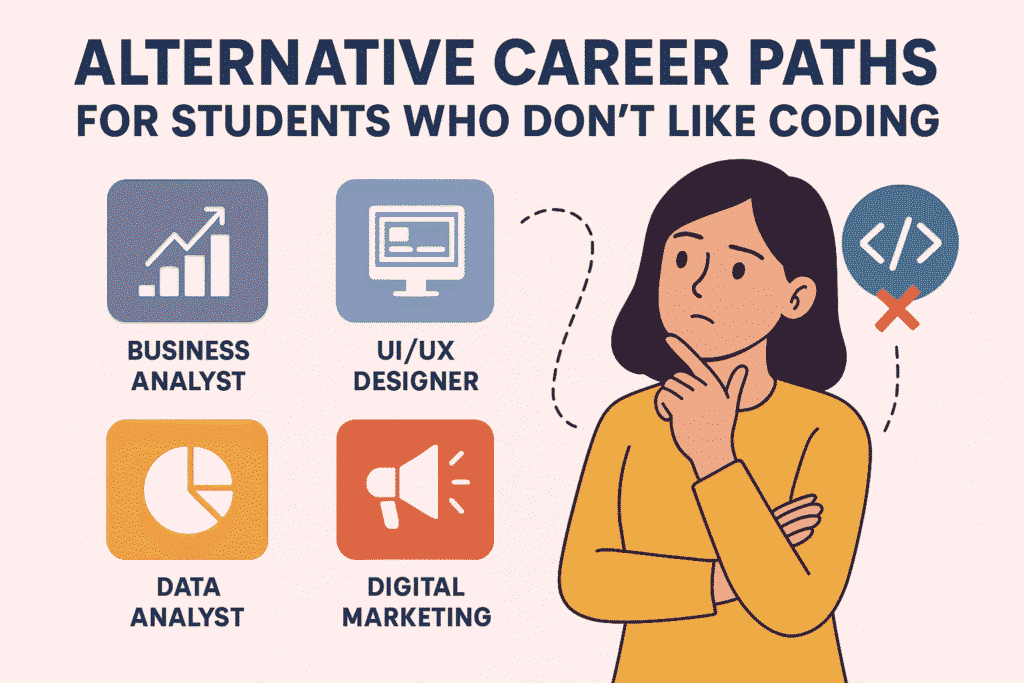
1. Business Analyst
What They Do:
Business Analysts act as a bridge between business teams and technical teams. They analyze company processes, gather requirements, and propose solutions to improve efficiency and performance.
Why It’s Great for Non-Coders:
While a basic understanding of technology is helpful, you don’t need to write code. Instead, your focus is on understanding business needs and translating them into actionable plans for developers and other stakeholders.
Key Skills Required:
- Strong analytical and problem-solving skills
- Communication and documentation abilities
- Knowledge of tools like MS Excel, Tableau, or Power BI
- Understanding of business processes and market trends
Average Salary:
Entry-level: ₹4–6 LPA (India) / $60,000–$80,000 (US)
With experience, salaries can reach ₹15 LPA or higher.
2. UI/UX Designer
What They Do:
UI (User Interface) and UX (User Experience) designers create the look, feel, and usability of websites and apps. They ensure that digital products are visually appealing and easy to use.
Why It’s Ideal for Creative Minds:
If you love design, psychology, and understanding how people interact with technology, this is a perfect non-coding career. Most of the work involves design software like Figma, Adobe XD, and Sketch rather than coding.
Key Skills Required:
- Creativity and a good design sense
- Understanding of user behavior and usability principles
- Proficiency with design tools (Figma, Photoshop, Illustrator)
- Basic knowledge of HTML and CSS is a plus, but not mandatory
Average Salary:
Entry-level: ₹3–6 LPA (India) / $55,000–$75,000 (US)
Senior designers can earn over ₹15 LPA or $120,000+ annually.
3. Data Analyst
What They Do:
Data Analysts help companies make data-driven decisions by collecting, processing, and interpreting data. They generate reports and insights to guide business strategies.
Why It’s a Great Option:
While advanced data science roles require coding, many entry-level data analyst jobs focus on tools like Excel, SQL, and visualization platforms such as Tableau or Power BI.
Key Skills Required:
- Analytical mindset and attention to detail
- Proficiency with Excel and statistical tools
- Knowledge of SQL for database queries
- Data visualization and storytelling skills
Average Salary:
Entry-level: ₹4–8 LPA (India) / $60,000–$85,000 (US)
Senior data analysts can earn significantly higher, especially in the finance and tech sectors.
4. Digital Marketing Specialist
What They Do:
Digital Marketing Specialists plan and execute online marketing campaigns to promote products and services. This includes SEO, social media marketing, content strategy, and paid advertising.
Why It’s Non-Technical:
You don’t need to code, though a basic understanding of website structure helps with SEO. Your focus will be on strategy, creativity, and analysis.
Key Skills Required:
- Knowledge of SEO and SEM practices
- Social media marketing and advertising expertise
- Content creation and copywriting skills
- Analytical skills for measuring campaign performance
Average Salary:
Entry-level: ₹3–5 LPA (India) / $50,000–$70,000 (US)
Senior marketers and managers can earn upwards of ₹15 LPA or $100,000+ annually.
5. Product Manager
What They Do:
Product Managers oversee the development and success of a product from idea to launch. They coordinate with developers, designers, and marketing teams to ensure the product meets customer needs.
Why It’s Perfect for Non-Coders:
While you need to understand the product’s technical aspects, you don’t have to build it yourself. Your role focuses on planning, strategy, and leadership.
Key Skills Required:
- Strong communication and organizational skills
- Strategic thinking and problem-solving
- Knowledge of project management tools like Jira, Trello, or Asana
- Understanding of user needs and market trends
Average Salary:
Entry-level: ₹8–12 LPA (India) / $90,000–$120,000 (US)
Senior roles can reach ₹30 LPA or $150,000+ annually.
6. Technical Writer
What They Do:
Technical Writers create user manuals, documentation, guides, and online help content for products and services.
Why It’s Non-Coding:
Your job is to explain technical information clearly rather than build the technology. This role is great for students with good writing skills and an interest in technology.
Key Skills Required:
- Strong writing and communication skills
- Ability to simplify complex concepts
- Familiarity with documentation tools like Confluence or Notion
- Basic understanding of the product’s functionality
Average Salary:
Entry-level: ₹3–5 LPA (India) / $50,000–$70,000 (US)
7. Sales and Business Development
What They Do:
Sales and business development professionals drive revenue growth by acquiring new clients, managing relationships, and identifying new business opportunities.
Why It Works Without Coding:
The focus here is on communication, networking, and persuasion, not technical development.
Key Skills Required:
- Excellent communication and negotiation skills
- Networking and relationship management
- Knowledge of the product or service being sold
- Strategic thinking and goal orientation
Average Salary:
Entry-level: ₹4–6 LPA (India) / $55,000–$80,000 (US)
Top performers can earn significantly higher with commissions.
8. Cloud Administrator or Cloud Support Specialist
What They Do:
Cloud Administrators manage cloud-based systems like AWS, Azure, or Google Cloud. They monitor performance, manage resources, and ensure security.
Why It’s Suitable Without Deep Coding Knowledge:
Most tasks involve configuration and management rather than hardcore coding. With certifications, you can enter this field quickly.
Key Skills Required:
- Knowledge of cloud platforms (AWS, Azure, GCP)
- Networking and system administration skills
- Problem-solving and troubleshooting abilities
- Certifications like AWS Certified Solutions Architect or Azure Fundamentals
Average Salary:
Entry-level: ₹5–8 LPA (India) / $70,000–$90,000 (US)
9. HR and Talent Acquisition in Tech Companies
What They Do:
Human Resource professionals recruit and manage tech talent, ensuring the organization has the right people to achieve its goals.
Why It’s Great for Non-Coders:
The focus is on people management, not technology. However, knowledge of the tech industry helps in understanding hiring needs.
Key Skills Required:
- Strong interpersonal and communication skills
- Talent sourcing and recruitment expertise
- Knowledge of HR software and platforms
- Conflict resolution and employee engagement
Average Salary:
Entry-level: ₹3–5 LPA (India) / $50,000–$70,000 (US)
10. Cybersecurity Analyst (Entry-Level)
What They Do:
Cybersecurity analysts protect systems and data from cyber threats. They monitor networks, conduct audits, and respond to security breaches.
Why It’s Non-Coding Friendly (Initially):
While advanced roles may require scripting, many entry-level positions focus on monitoring, reporting, and compliance rather than programming.
Key Skills Required:
- Knowledge of cybersecurity tools and practices
- Analytical and problem-solving skills
- Understanding of networks and systems
- Certifications like CompTIA Security+ or CEH
Average Salary:
Entry-level: ₹5–8 LPA (India) / $65,000–$85,000 (US)
Steps to Build a Non-Coding Career
Here’s how you can start building a successful career without coding:
- Identify your interests and strengths – Creativity, analysis, communication, or management.
- Choose a career path – Based on your interests, select one of the roles above.
- Upskill through certifications and online courses – Websites like Coursera, Udemy, and LinkedIn Learning are great resources.
- Build a strong resume and portfolio – Showcase your projects, case studies, and achievements.
- Network and gain experience – Attend webinars, internships, and industry events.
- Apply strategically – Target companies and roles that match your skills.
Final Thoughts
Not liking coding doesn’t mean you can’t succeed in the tech world or other industries. Today’s job market offers diverse, high-paying roles that leverage different skill sets—from creativity and strategy to analytics and management.
The key is to know your strengths, explore different opportunities, and continuously upskill. Whether you choose to become a business analyst, digital marketer, UI/UX designer, or cloud administrator, remember that there is always a place for you in the modern workforce.
So, embrace your unique talents, and start building a future that excites you—without ever needing to write a single line of code.
Table of Contents
follow us on whatsapp channel